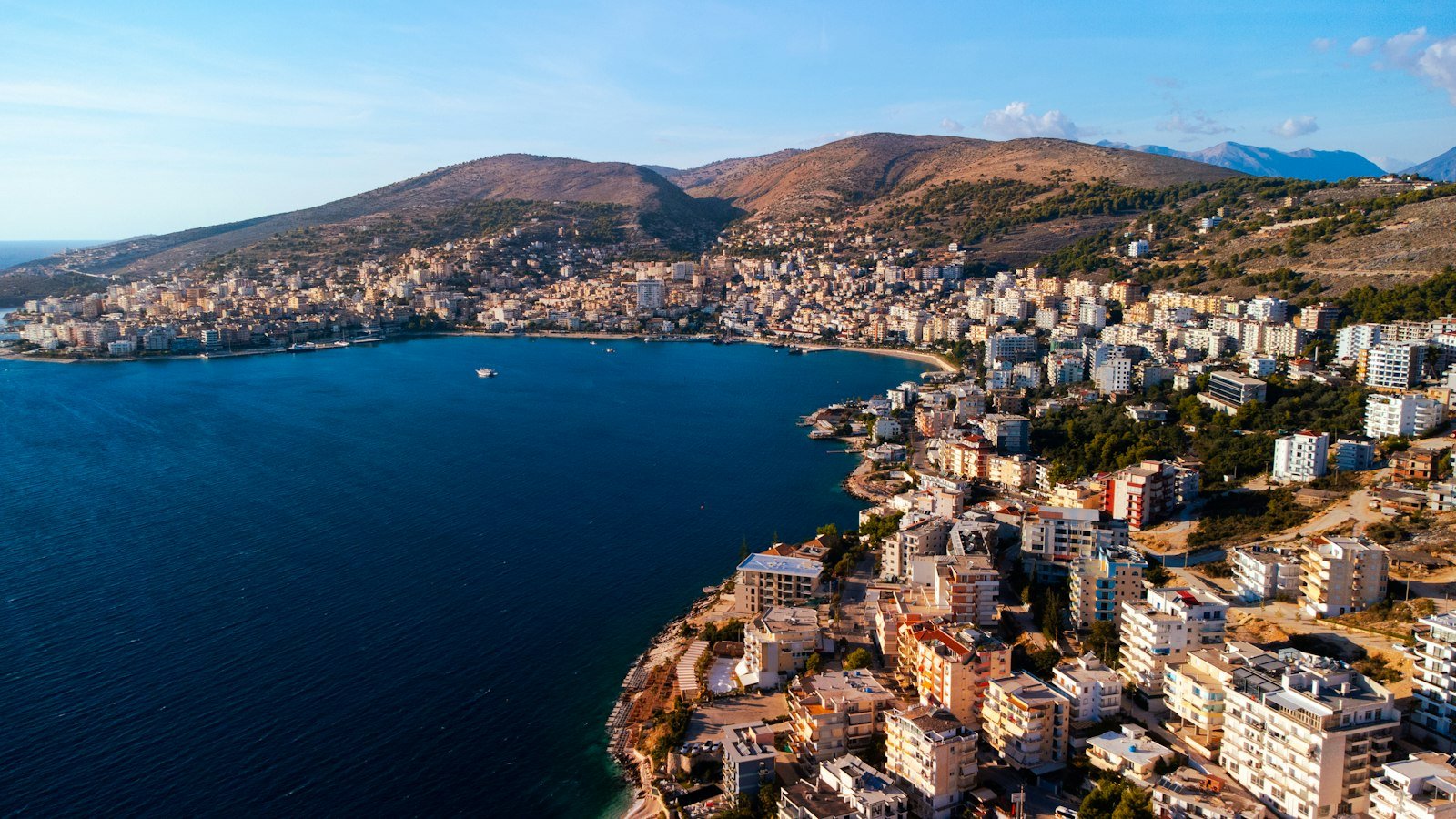
In short: The main things to do in Saranda are walking the seafront promenade, swimming at the town and Ksamil beaches, climbing to Lekursi Castle, and visiting Butrint, a UNESCO World Heritage site 14 km south. The Blue Eye spring, Gjirokaster, boat trips along the coast and the ferry to Corfu fill the remaining days.
Saranda (Sarandë in Albanian) is a coastal town in southern Albania on the Ionian Sea, opposite the Greek island of Corfu. It sits on an arch-shaped bay and has a Mediterranean climate with more than 300 sunny days a year. Most of the sights below are inside the town or within about an hour of it, so the town works as a base for the far south. For the wider country, see our guide to things to do in Albania.
Tours listed by GetYourGuide. We may earn a commission if you book, at no extra cost to you.
The promenade and town beaches
The Albanian National Tourism Agency lists the city promenade among the most visited places in Saranda. It runs along the bay beside the town beach. The same agency names several beaches and bays in the Saranda area, including Mirror Beach, Monastery Beach, Krorëz Beach, Kakome Bay and Pema e Thatë Beach.
Two small historic sites are also in or near the centre. The ruins of the old synagogue were later replaced by a church in the 6th century. The Monastery of the 40 Saints, about 1 km south-east of the modern town, gave Saranda its name.
Lekursi Castle
Lekursi Castle (Kalaja e Lëkurësit) stands on a hill above the town. According to the national tourism agency, it was built in 1537 under Sultan Suleiman the Magnificent to protect the port and to control sea and land routes against Venetian influence. Fortified walls and parts of the interior buildings remain. The hill gives a wide view over the town, the coast and the Ionian Sea.
Butrint
Butrint is an ancient city about 14 km south of Saranda, near the Greek border. It was added to the UNESCO World Heritage list in 1992 and has been a national park since 2000. The site was settled by the Chaonians, became a Roman colony, and was later held by Byzantium and Venice. The main monuments are the theatre, the baptistery with its large mosaic, the 6th-century Grand Basilica and the Lion Gate.
The park’s own website lists these 2026 prices and hours. It also notes that entry fees change from 1 January 2027.
| Item | Details from butrint.al |
|---|---|
| Individual ticket | 1,000 lek, covering the park, the Butrint Museum and the Triangular Castle |
| Group ticket (more than 10 people) | 800 lek per person |
| Reduced ticket | 50% of the price for students, children aged 12 to 18 and pensioners with proof |
| 1 April to 31 October | Entry 08:30 to 18:00, park closes at 20:00 |
| 1 November to 31 March | Entry 09:00 to 15:00, park closes at 17:30 |
Guided visits can be compared through Butrint tours on GetYourGuide (we may earn a commission if you book).
Ksamil
Ksamil is a coastal village south of Saranda on the road to Butrint, about 14 km from town. It is part of Butrint National Park and is known for white sand beaches and the small Ksamil Islands just offshore. A 2026 transport guide reports a local bus from Saranda roughly every hour in summer, taking 20 to 30 minutes, with a cash fare of about 200 lek to Ksamil and 250 lek to Butrint. Fares have changed from year to year, so carry small notes. Our Ksamil beaches page covers the individual beaches.
The Blue Eye (Syri i Kaltër)
The Blue Eye is a karst spring near the village of Muzinë, inland between Saranda and Delvinë. Water rises from a hole whose full depth is unknown. Divers have gone down about 50 metres. The spring discharges around 18,400 litres per second and is the source of the Bistricë river, which runs to the sea south of Saranda. It has been a protected natural monument since 1996.
The spring is close to the Saranda to Gjirokaster road, so many people combine the two in one day. Not every bus stops at the turn-off, so ask the driver before boarding.
Day trip to Gjirokaster
Gjirokaster is about 53 km from Saranda by road, over the Muzinë pass and down into the Drino valley. The drive takes roughly 1 hour to 1 hour 15 minutes. Buses take about 1 hour 20 minutes and cost around 400 to 500 lek, with three to five departures a day in each direction.
The historic centre has been on the UNESCO list since 2005, together with Berat. It is called the “City of Stone” after the stone roofs of its Ottoman-era houses. The fortress above the town has a clock tower and a military museum, and the old bazaar sits below it. Timetables are seasonal, so hiring a car gives more control over the return.
Boat trips
Group boat trips leave from the Saranda waterfront and head north along the coast. Krorëz Beach and Kakome Bay are the usual stops. One listing we read runs for six hours, meets on Rruga Jonianet, and includes beach time at Krorëz and lunch. Routes, boat types and inclusions differ between operators, so compare a few Saranda boat tours or the full list of Saranda tours and activities before choosing.
Day trip to Corfu by ferry
Ionian Seaways sails between Saranda and Corfu all year. Its timetable gives a crossing of about 30 to 45 minutes by hydrofoil and 55 to 70 minutes by passenger and car ferry. Times are shown in local time.
| 2026 period | From Saranda | From Corfu |
|---|---|---|
| 1 July to 30 September | 12 sailings, first at 06:00 | 13 sailings, last at 22:30 |
| 11 November to 31 December | 10:00 (Sunday to Thursday), 14:00 (Friday and Saturday) | 09:00 daily |
In summer a same-day return is simple. On the winter timetable the only boat from Corfu leaves before the boat from Saranda arrives, so a Corfu visit needs an overnight stay. See the Corfu to Saranda ferry guide for details, or the Corfu to Albania day trip page if you are coming the other way.
Getting there
The two usual routes are the ferry from Corfu and the road from Tirana. Buses on the inland route from Tirana take about 4.5 to 5 hours and cost around 1,500 lek, arriving at the bus terminal at Qafë Gjashtë, about 2 km above the port. Our Tirana to Saranda and Tirana to Ksamil pages compare the options. For places to stay, see Albania hotels, and check the best time to visit Albania before fixing dates.
Prices come from our booking partner and open on their site. We may earn a commission if you book, at no extra cost to you. How this works
For a second set of tours and tickets, compare the same activity on Klook (we may earn a commission if you book, at no extra cost to you).
Questions people ask
How many days do you need in Saranda?
The town, promenade and Lekursi Castle fit into one day. Butrint and Ksamil take a second day, and the Blue Eye with Gjirokaster takes a third. Add another day for a boat trip or, in summer, a return ferry to Corfu.
How much is the entry ticket for Butrint?
The park’s website lists an individual ticket at 1,000 lek, which includes the Butrint Museum and the Triangular Castle. Groups of more than 10 pay 800 lek each, and students, children aged 12 to 18 and pensioners pay half. Fees change from 1 January 2027.
Can you visit Corfu from Saranda in one day?
Yes, in summer. From 1 July to 30 September 2026 the Ionian Seaways timetable shows 12 sailings from Saranda and 13 back from Corfu. From 11 November to 31 December there is one boat each way, and the times do not allow a same-day return.
How far is the Blue Eye from Gjirokaster and Saranda?
The Blue Eye lies near Muzinë on the road between the two towns, which are about 53 km apart. Some Saranda to Gjirokaster buses pass the turn-off, but not all stop there, so ask the driver first or go by car.
Sources
- Albanian National Tourism Agency: Saranda
- Albanian National Tourism Agency: Lëkurës Castle
- Butrint National Park: tickets
- Butrint National Park: visitor information and opening hours
- Ionian Seaways: Corfu and Saranda timetable 2026
- Wikipedia: Butrint
- Wikipedia: Sarandë
- Wikipedia: Ksamil
- Wikipedia: Blue Eye, Albania
- Wikipedia: Gjirokastër
- Himara.net: Saranda to Ksamil bus guide
- Himara.net: Saranda and Gjirokastër transport
- Himara.net: Tirana to Saranda bus guide
- Headout: Krorez boat tour from Saranda (listing)
Last checked: 23 November 2026.